
Playing in the Space Between Conversation and Silence
On what happens when a group allows periods of silence

I’ve been playing with silence this week.
It started with a meeting I had on Tuesday for a veteran’s charity. The tradition is to start the meeting with two minutes of silence in remembrance of those who gave their lives. I got my timing wrong, so the silence was about three minutes. It was deeply moving for me on a lot of levels which I won’t go into here. But I came away thinking - what happens if we start playing a bit more with silence?
And so, this Friday morning at seven o’clock, five of us were on Zoom. I suggested we spend the first three minutes in silence - to centre ourslves. It set the tone for the rest of the 90 minutes.
It wasn’t an awkward silence. It was actually quite comforting for everyone to know that they weren’t expected to speak. It allowed everyone to settle into the stillness of the session. To put down any distractions. To centre themselves in the moment.
An hour after the session ended, one of the group sent me a message. The whole session had felt, she said, like a deep meditation. She hadn’t expected that. Neither had I. But I recognised what she meant, because I’ve felt the same way all day.
Something had happened in the online room this morning which I hadn’t experienced before and I’d like to explore it with you.
I have been developing a model I call the Five Rings of Attention which I introduced last week. Think of it as a target, with five concentric rings moving from the outside in.
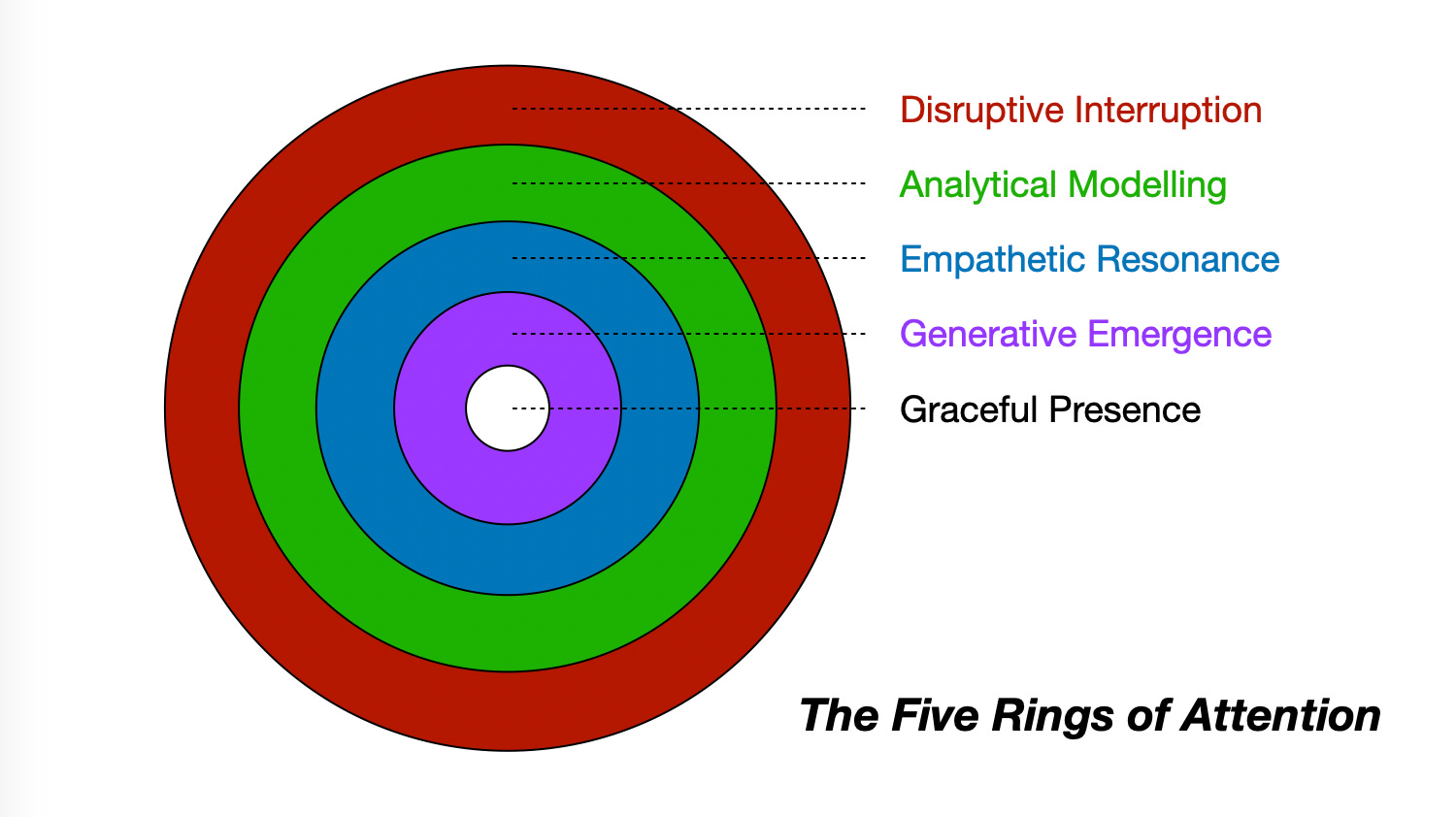
The outermost ring is Disruptive Interruption. This is what happens when attention fragments: someone checks their phone, a notification fires, a thought pulls a person away before the speaker has finished. Most meetings spend more time here than anyone admits.
The next ring is Analytical Modelling. This is where most professional meetings aim, and often arrive. People are processing ideas, building arguments and exchanging information. It is useful, but limited, because it is still primarily each individual mind working on material put in front of it and trying to make it fit with their own mental models of how the world works.
The third ring is Empathetic Resonance. Here something shifts. People are no longer just thinking about what is being said. They are feeling into it. They are tracking each other’s feelings, not just the content. And they are empathising through words and sometimes actions.
The fourth ring is Generative Emergence. This is where new ideas emerge that no one individual brought into the room. Ideas form in the space between people rather than from any particular person. The conversation becomes genuinely collective.
And at the centre: Graceful Presence. This is the ring most meetings never reach. It is not silence exactly, though silence can take you there. It is a quality of attention so open and so still that something deeper than thought becomes available. It is this space I wanted to experiment with today and I was very happy to receive the message after the meeting that confirmed my own sense of calm and peacefulness after the experience.
The question is, how did we achieve it?
We spent quite a lot of the meeting moving inward from the outside through each of the rings - not necessarily in sequential order either.
One member described his garden. Eighteen years of tending trees, plants, birds, and the river at the edge. One quote particularly struck me: “The garden is gardening me,” he said, “rather than the other way around.”
We talked of natural things lining up and pulling you into the future and then someone described his practice of setting intent and then releasing it entirely. You aim, he said, and then you let the arrow go. You watch for what comes back. The pushing is only half of it. The receiving is where the real movement happens.
I then told the group about whittling workshop I had been on the previous Sunday. How I found a stick with a knob of wood on top of it - and the knob had a hole in it.
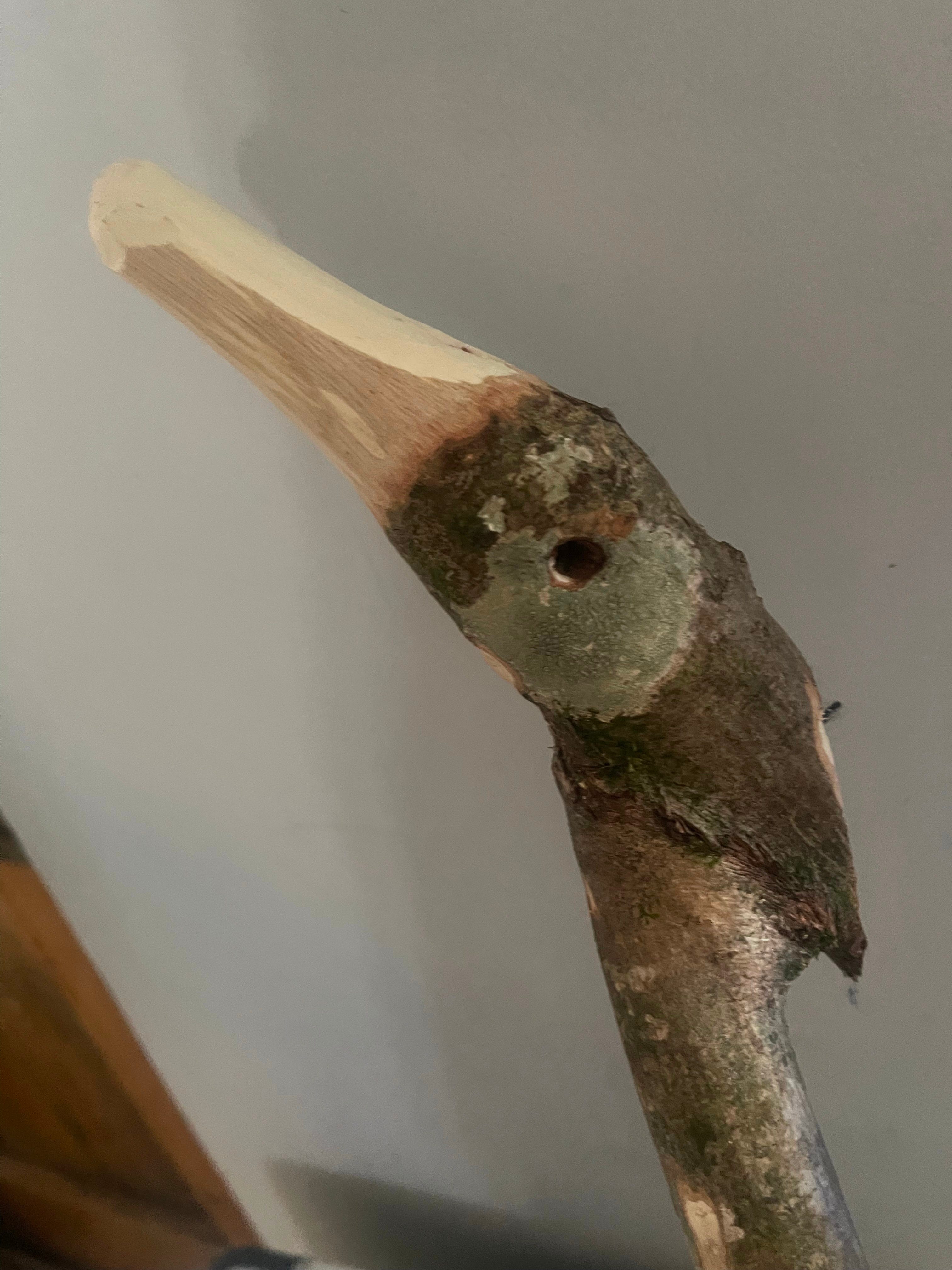
Is it a Stick or is it a Duck?
If you turned it a few ways you can see a duck’s head. I’m still carving it - but everything after that insight was just removing what wasn’t duck. I love the quote by Antoine de Saint-Exupéry “A designer knows he has achieved perfection not when there is nothing left to add, but when there is nothing left to take away.” Somehow carving the wooden stick has really brought that idea to life for me.
What I notice, looking back, is that each of these stories carried a similar structure. Something is already there (trees, targets, sticks and ducks). The work is not to add to it but to attend to it carefully enough that it can reveal itself.
That is also a description of what happens in the fourth ring.
After about an hour of dialogue, I suggested we hold a longer period of silence. More opportunity for relaxing into a state of presence. I had a strange feeling during that silence. I felt strongly the member of the group who hadn’t made it because he was ill.
That surprised me. Or rather, it surprised the part of me that still assumes connection requires physical presence, and that absence is simply nothing. Something had been taken away that was too much. I wanted it back.
Another member had been reading Jan Smuts book: “Evolution and Holism” published in 1924. In it, he argued that all beings strive to become wholes and parts of larger wholes. This group had already become a whole last week. His absence was felt inside that wholeness. Belonging, it turns out, does not switch off when someone leaves the room. And I know he was longing to join - because he told me.
Toward the end of the session, one member described a Taoist teaching lineage in which knowledge passes heart to heart. Not from teacher to student as information transferred, but something carried through the quality of attention itself. The tenth person in that lineage, somewhere in North London, receives something that has been deepened through every transmission between the nine hearts before them.
He reminded us that in Chinese tradition, the mind resides in the heart, not the head.
Somehow, by the end of the session, the quality of attention was so much stronger than anything I’ve felt for a long time and it has stayed with me for the rest of the day. It’s extraordinary that you can do this in an online Zoom session when each participant is in a different country many miles apart from each other.
This dialogue circle was not set up as a meditation practice. We are not following breath or mantras. We are talking, listening, sometimes going quiet, seldom interrupting each other. Giving each other space to be. We had no teacher, no technique, no particular destination.
And yet. When a group moved through the rings toward that centre, something indistinguishable from meditation seemed to happen. Not because we sought it, but because we stopped blocking it.
One member of the group quoted Carl Jung: “Our biggest obstacle is who we’ve become.” I think this applies to meetings as much as to people. Most meetings have already decided what they are before they begin. Pre-written agendas. Lists of action points. Charts and graphs sharing current status. They are locked in the outer rings, never allowing for deeper meaning to emerge.
We ended with a short period of music. Another type of no-words which rounded the session off.
So here is a suggestion. I offer it to anyone who leads meetings, facilitates groups, or simply sits in rooms with other people hoping something useful might emerge.
Build in silence. In several places. At the start. In the middle. At the end.
Not as a gap between agenda items. Not as a pause for effect. As a deliberate invitation for attention to move inward. Ask people to put down their phones and tablets. Ask them to put their attention into the room itself. Then wait.
You do not need to frame this as meditation. You do not need to frame it as anything. You just need to create the space, and trust that something will move into it.
The most important conversations I have ever been part of did not begin with an agenda. They began with a quality of attention that made room for something unexpected to arrive.
Playing in the space between conversation and silence. Work with it and see what happens!
Please do comment if any of this resonates with you!
So beautifully written, the magic of really being present with what's in front of you without any agenda or other forced idea is palpable through your words! Each of your personal participants' reflections on how they've experienced this in their lives is inspiring, thank you for sharing! I volunteer with a Climate Emergency Center where I live, and we always start our meetings with a 'check-in' which is about arriving into the space before we start discussing anything, but I'd love to bring your offer of building in silence to them and see how that changes our gatherings.
Brilliant and inspiring Lorne thanks 🙏